



Managing HVAC portfolios: why 2026 looks different
Facility directors and property managers used to manage HVAC one building at a time: local BAS panels, manual schedules, and a mix of vendors and control logic that evolved over the years. In 2026, multi‑site portfolios face rising energy costs, ESG reporting pressure, and more complex occupancy patterns, especially with hybrid work and mixed‑use spaces. If you’re managing HVAC across dozens of buildings, you don’t have a controls problem—you have a portfolio problem. This article shows how IoT building automation lets you see, standardize, and fix HVAC issues across every site from one pane of glass.
Traditional approaches struggle in three ways across portfolios:
Limited visibility across sites – you see alarms, not patterns.
Inconsistent comfort and control – each building behaves differently, often with conflicting sequences.
Maintenance driven by complaints and emergencies rather than data.
IoT‑based building automation is being adopted specifically to solve these portfolio‑level problems, not just to upgrade a single site. 75F’s IoT Building Management System is designed for multi‑building portfolios, combining smart sensors, cloud controls, and machine learning to manage thousands of zones across diverse geographies.
The core HVAC challenges across multiple buildings
1. Fragmented control and blind spots
Most commercial portfolios have a mix of controls: older BAS installations, standalone thermostats, and inconsistent sequences from different integrators. In practice, that means facility leaders lack a single-pane-of-glass view of HVAC performance, comfort, and energy use across sites.
Common symptoms:
No standardized schedules or setpoints across similar buildings.
Difficulties comparing performance or energy intensity across sites.
Local overrides that drift from design intent and stay in place for months.
2. Comfort and indoor air quality inconsistency
Across a portfolio, one site may run cold, another warm, and a third with CO₂ levels that regularly exceed recommended thresholds due to limited ventilation control. When HVAC is managed in silos, there is no standard for comfort bands, IAQ targets, or occupant feedback loops across buildings.
Tenants feel that inconsistency. It shows up as:
Temperature complaints and hot/cold calls at specific sites.
Under‑ventilated spaces in high‑occupancy zones, especially in offices and retail.
Difficulty maintaining WELL‑style or internal IAQ standards everywhere, not just flagship buildings.
3. Maintenance driven by “fire drills”
Without real‑time HVAC intelligence across sites, maintenance teams react to problems when they become visible: comfort complaints, equipment alarms, or outright failures. In 75F’s predictive maintenance article, we discuss how a six‑hour chiller failure in a 180,000‑square‑foot office building is estimated to cost more than $400,000 in total impact, while the repair invoice represents less than 4% of that amount.
Across multiple buildings, that pattern compounds:
Emergency callouts at odd hours in different cities.
Technicians traveling between sites to troubleshoot issues that could have been predicted.
Difficulty planning capital budgets because failures feel random rather than data‑driven.
How IoT building automation solves portfolio‑wide HVAC challenges
IoT building automation brings three capabilities that matter for multi‑building HVAC management: dense sensing, cloud‑based controls, and portfolio‑wide analytics.
Standardized sensing and sequences in every building
75F’s platform embeds smart sensors directly into thermostats and control hardware, pulling continuous data on temperature, humidity, CO₂, VOCs, occupancy, light, and sound from every zone. That data feeds pre‑engineered control sequences that align with standards like ASHRAE Guideline 36 and demand‑controlled ventilation recommendations.
Across a portfolio, this delivers:
Consistent control logic for VAV boxes, air handling units, and packaged RTUs, regardless of building age.
Unified comfort bands and ventilation strategies across similar spaces, such as offices or multi‑family corridors.
A baseline for comparing performance between sites with the same sequences and sensors.
Cloud control and remote management from one pane of glass
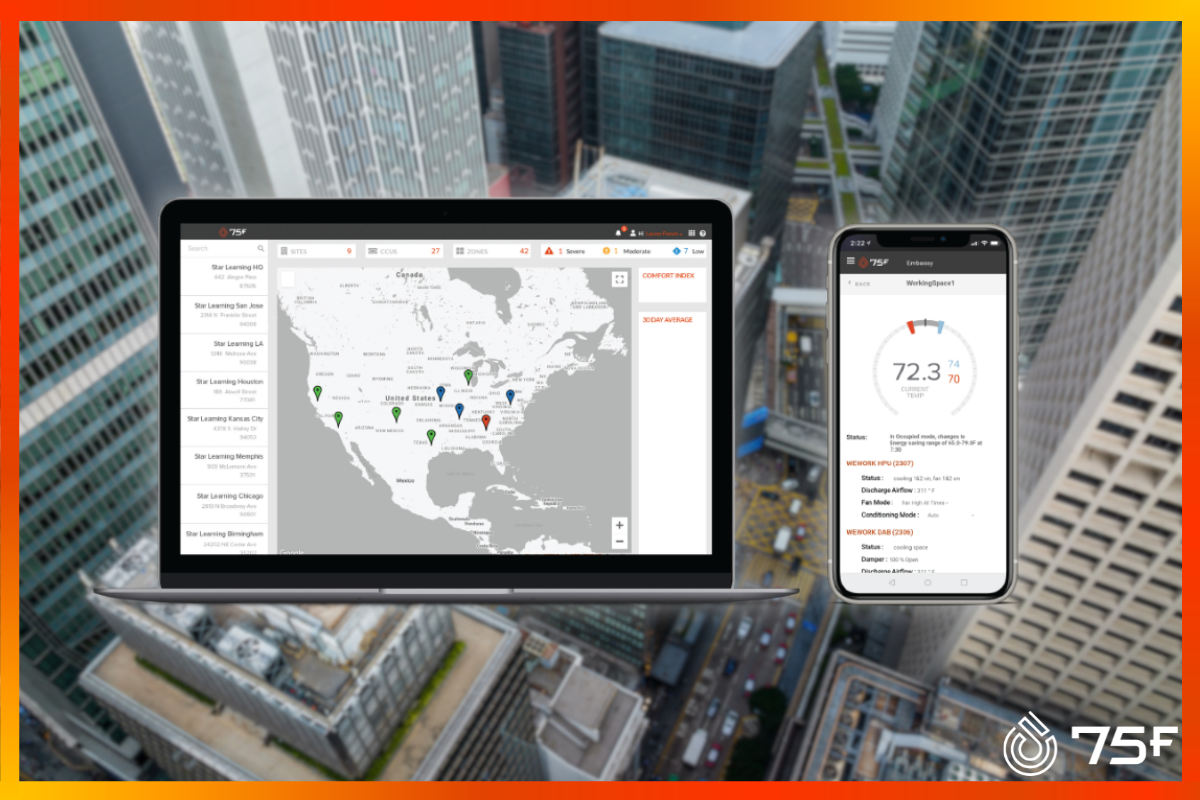
With Facilisight®, facility leaders can monitor and manage HVAC across all sites from a single web and mobile interface, drilling from portfolio view down to individual floor, zone, and equipment levels. The platform streams hundreds of data points per minute per building into the cloud, giving real‑time insight into equipment health, temperature, and IAQ across the portfolio.
Key multi‑site features include:
Heatmaps that show which zones across buildings are too hot, too cold, or under‑ventilated.
Named Schedules that can be applied to similar spaces across different buildings in a few clicks, rather than programming each BAS separately.
Vacation and special schedules that handle holidays and events across sites without manual on‑site programming.
Predictive intelligence and continuous commissioning
Earlier 75F articles highlight how IoT and AI enable predictive maintenance, reducing unplanned downtime and maintenance costs compared to reactive approaches. When that intelligence runs across a portfolio, facility leaders can identify patterns that would never be visible at a single site: which buildings generate more comfort complaints, which units show early signs of failure, and where energy intensity spikes.
Examples you already document in your case studies:
Identifying an exhaust fan that had not been working for years, causing chronic overheating and elevator shutdowns, and eliminating that problem after 75F deployment.
Achieving total building energy savings in the 20–30% range in real‑world commercial sites by pairing IoT sensing with adaptive controls.
Multi‑building HVAC management capabilities: traditional vs IoT automation
| Capability | Traditional multi-site BAS | Standalone EMS (energy only) | IoT building automation with 75F |
| Portfolio-wide HVAC visibility | Limited; views siloed by building | Energy data, but no HVAC control | Single pane of glass across all sites |
| Standardized control sequences | Varies by integrator and site | Not in scope | Pre-engineered, consistent across sites |
| Scheduling across multiple buildings | Manual programming per panel | Not in scope | Cloud "Named Schedules" pushed portfolio-wide |
| Comfort and IAQ consistency | Dependent on local configuration | Reports consumption only | Sensors and IAQ logic in every zone |
| Predictive maintenance | Limited fault detection, site-specific | can see anomalies but cannot act | continuous monitoring and prioritized alerts |
| Multi-site energy benchmarking | Manual data collection, often incomplete | Core EMS function | Portfolio Energy Manager with kWh, intensity, and cost PSF |
| Remote control and overrides | Often on-premises only | No control | Full remote control from web and mobile apps |
| Integration with legacy equipment | Varies; may require custom work | Not applicable | IoT-native controls plus integrations frameworks like FIN |
Practical steps for facility leaders managing multi‑site HVAC
Step 1: Baseline each building – then your portfolio
Start by collecting the basics for each building: floor area, HVAC equipment types, existing controls, and the last 12–24 months of energy use and maintenance spend. Once you have that, normalize energy data across sites by square footage and, where possible, weather, to see which buildings are outliers. Tools like 75F’s Portfolio Energy Manager provide kWh, intensity, and cost per square foot in a single visualization, making these comparisons straightforward.
Step 2: Identify your highest‑impact HVAC challenges
Across multiple buildings, look for:
Sites with chronic temperature complaints or IAQ issues.
Buildings with disproportionately high HVAC energy use per square foot.
Locations that rely entirely on manual thermostats or legacy panels without modern fault detection.
These sites often offer the fastest payback for an IoT automation deployment, especially when paired with utility incentives or demand response programs, as discuss in our recent demand response article.
Step 3: Deploy standardized IoT controls and sensors
Moving to an IoT‑based building management system means installing smart thermostats and controllers that are pre‑programmed, wireless, and designed to work as a unified system out of the box. 75F’s solutions for VAV and other equipment emphasize retrofit‑friendly installation and remote diagnostics, reducing installation time relative to traditional BAS.
At the portfolio level, prioritize:
High‑occupancy buildings (offices, retail, education, multi‑family) where comfort and IAQ drive revenue or tenant retention.
Sites where traditional BAS upgrades would be cost‑prohibitive.
Step 4: Centralize schedules, comfort bands, and IAQ targets
Once IoT devices are in place, configure common schedules and comfort bands across similar buildings using cloud tools rather than local panels. 75F’s scheduling features allow you to create Named Schedules for standard office hours or retail patterns and apply them across zones and sites.
Set clear targets for:
Temperature ranges in occupied vs standby modes.
IAQ thresholds for CO₂ and humidity that align with your internal standards or WELL‑style guidance.
Step 5: Shift maintenance from reactive to predictive across sites
With continuous data streaming from every building, you can use analytics to detect early‑stage issues: rising motor current, unusual temperature deltas, or persistent deviations from expected comfort performance. Instead of dispatching technicians when something fails, you can schedule interventions when trending data shows specific assets need attention.
Across multiple buildings, this enables:
Fewer emergency callouts and more planned work orders.
Better allocation of technician time to the sites with the greatest risk or highest savings potential.
Capital planning that’s based on actual asset condition data rather than age alone.
Frequently Asked Questions
What is HVAC management across multiple buildings?
HVAC management across multiple buildings means controlling, monitoring, and maintaining heating, cooling, and ventilation systems across an entire portfolio from a unified platform, rather than treating each building as a separate project.
Why is IoT building automation important for multi‑site portfolios?
IoT building automation adds dense sensing, cloud‑based controls, and analytics to every building, giving facility leaders real‑time visibility and standardized control sequences across sites so they can improve comfort and cut energy waste.
Can I manage schedules for multiple buildings from one interface?
Yes. With cloud‑based tools like 75F Facilisight®, you can create shared schedules and apply them across zones and buildings, adjust for holidays or special events, and rely on occupancy‑based features like Auto Away to adapt settings in real time.
How does IoT monitoring reduce HVAC maintenance costs?
Continuous sensor data lets you detect early‑stage equipment issues and energy‑wasting faults before they become failures, shifting work from emergency repairs to planned maintenance and reducing total maintenance and downtime costs.
What’s the first step to modernizing HVAC across my portfolio?
Start by baselining energy use, comfort complaints, and controls for each building, then prioritize sites with the highest HVAC spend or most frequent issues for IoT automation, focusing on standardized sensors and cloud controls that scale across your portfolio.
Sources





Healthier Buildings Series: Real Estate Strategies in Times of Uncertainty
Commercial real estate is in a completely different landscape today than it was 12 months ago.

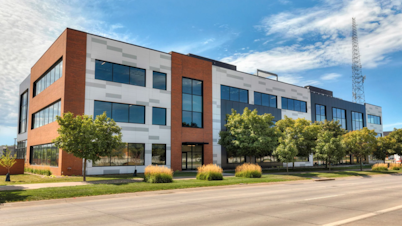
75F Makes IntelliPak RTU Integration Simple in High-End Office Space
Hubbell Realty installed 75F's IoT Building Management System with goals to set a flexible foundation for future building upgrades.