




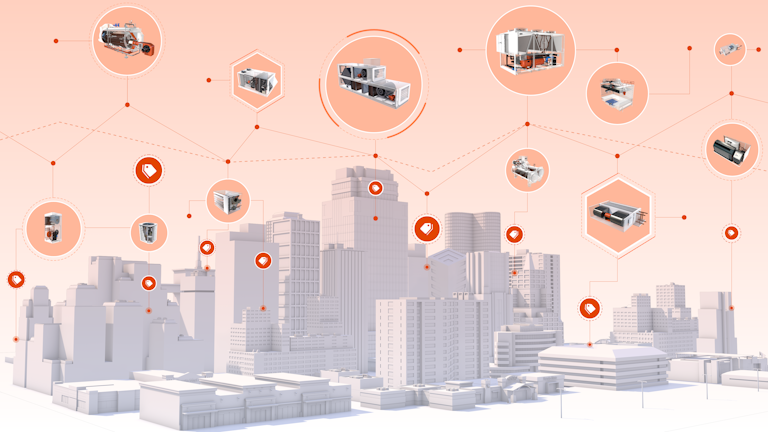
What Is a Smart Building Management System for Existing HVAC Systems?
Most commercial buildings still run on HVAC controls that were programmed once and rarely revisited, even though HVAC often accounts for a large share of total building energy use in offices and similar facilities. At the same time, building owners are under pressure to reduce energy costs, meet ESG targets, and prove indoor air quality to tenants and employees.
A smart building management system (smart BMS) solves this by layering IoT sensors, cloud software, and automation on top of your existing HVAC equipment, turning a static system into a continuously optimizing one. For commercial real estate managers and corporate facilities directors, this means you can modernize controls and cut energy waste without tearing out working rooftop units, VAVs, or boilers.
What is a smart building management system?
A smart building management system is a centralized, digital platform that monitors and controls a building’s mechanical, electrical, and environmental systems using IoT sensors, networked controllers, and software. Instead of relying on fixed schedules and manual overrides, a smart BMS responds to live data—occupancy, weather, indoor air quality, and equipment performance—to optimize comfort and energy automatically.
Traditional BMS platforms were often on-premises, custom-programmed, and cost-effective only for very large buildings. A smart, IoT-native BMS like 75F moves most of the intelligence to the cloud, uses wireless sensing, and ships with pre-engineered control sequences so that mid-market buildings get enterprise-grade automation without enterprise-grade complexity or cost.
How a smart BMS connects to your existing HVAC
For existing buildings, integration is the critical test. If you need to replace all your equipment to get “smart,” it is not a practical solution for most portfolios. A retrofit‑friendly smart building management system usually connects to existing HVAC in three ways:
Field‑level devices: Smart thermostats like HyperStat and MyStat, zone controllers, and multi-sensors mount in place of or alongside existing stats and VAV controllers, adding granular data and control without changing the underlying RTUs, AHUs, or boilers.
Open protocol integration: Gateways and controllers speak common protocols like BACnet and Modbus to exchange points with existing BMS infrastructure, meters, or packaged equipment. 75F’s HyperStat is BACnet-listed and can operate as a BACnet device on existing MSTP networks, which is important for buildings with an existing BMS.
Cloud and APIs: Data streams from edge devices into a cloud platform for analytics, dashboards, mobile access, and AI optimization, which then sends back control commands to local devices.
In practice, this means you can start by replacing legacy thermostats with HyperStat, adding Smart Nodes at critical equipment, and integrating with BACnet where you already have a supervisory BMS—rather than ripping out functional central plant or air‑side equipment.
What makes a BMS “smart” vs. traditional?
A building can have a BMS without being truly “smart.” The difference comes down to how much real‑time data the system sees, how decisions are made, and how easily it can be deployed and maintained.
Key characteristics of a smart building management system include:
IoT‑native sensing: Dense networks of sensors measure temperature, humidity, CO₂, VOCs, occupancy, and other parameters in real time at the zone level, using multi-sensor devices like the HyperStat BACnet.
Cloud and AI optimization: Control logic runs in the cloud and continuously learns building behavior, instead of depending on static sequences buried in a field controller.
Autonomous, high‑performance sequences: Systems automatically reset supply air temperature, duct static pressure, flows, and ventilation rates based on live demand, often following or exceeding ASHRAE Guideline 36 best practices.
Continuous commissioning: The platform constantly tunes setpoints and flags faults, rather than relying solely on one‑time commissioning during construction or retrofits.
Open interoperability: Support for open protocols such as BACnet allows integration with third‑party equipment and software instead of a closed, single‑vendor stack.
75F’s platform is designed around these principles. At the edge, devices like HyperStat, HyperStat Split, MyStat, and wireless terminal controllers feed rich data back to the Central Control Unit (CCU). In the cloud, Facilisight and Saffron AI turn that data into insight and automated control, pushing updated sequences and features over the air for the life of the system.
Smart vs. traditional BMS for existing buildings
The table below summarizes how a traditional BMS compares to a smart, IoT‑based BMS such as 75F when you are working with existing HVAC systems.
| Aspect | Traditional BMS | Smart Building Management System (75F Example) |
| Architecture | On-premises, controller-centric architecture with localized logic | Cloud‑native, IoT‑centric with wireless sensors and software-defined devices |
| Control Logic | Fixed schedules and custom code per project, rarely updated after commissioning | Pre‑engineered high-performance sequences with cloud-based optimization |
| Sensing | Limited points, mainly temperature and a few status signals | Multi-sensor devices measuring temperature, humidity, CO₂, VOCs, occupancy, light, sound, and PM2.5 in some configurations |
| Commissioning | Manual, time-intensive commissioning by controls engineers | Easy Street one‑click validation creates automated punch lists and simplifies commissioning; independent studies show VAV installs can be completed in a fraction of traditional time |
| Retrofit effort | Often requires new cabling, custom programming, and more downtime | Wireless overlays and BACnet integration with existing equipment and BMS networks |
| Energy impact | Typical savings in the low double-digits, heavily dependent on implementation quality. | NREL-backed modeling shows up to 31% total building energy savings for medium offices when using 75F sequences |
Why smart BMS is ideal for existing HVAC systems
1. Retrofit-friendly controls instead of rip-and-replace
Most of the commercial stock was built before modern IoT controls, and many buildings either have no BMS or an aging one that’s difficult to expand. Wireless smart thermostats and sensors can be installed without running new communication cabling, which reduces disruption in occupied spaces.
This is particularly important in tenant-occupied offices, healthcare clinics, and schools where downtime is expensive. By tackling zone controls and data visibility first, a smart BMS lets you modernize the control layer while preserving major investments in central plant and air-side distribution.
2. Open interoperability with existing BMS and equipment
In many portfolios, you’re not starting from zero—you already have some Johnson, Siemens, Honeywell, or other controls in place. Because HyperStat is BACnet-listed and can act as a BACnet server device, 75F can participate in existing BACnet MSTP networks and share data and control points with other systems.
This “overlay, don’t overwrite” approach lets you extend the life of legacy systems while gaining modern analytics, IAQ visibility, and better zone control.
3. Faster deployment and less manual testing
Traditional wired BAS projects can be slow to commission because engineers must manually test and validate point-by-point logic. Easy Street is described by 75F support documentation as a feature designed to automate functionality and logic checks for CCUs, eliminating the need for manual testing and providing an installation score.
For multi-site portfolios, that kind of automation and repeatable workflow makes it more realistic to roll out smart BMS capabilities across dozens of similar buildings without turning each location into a custom controls project.
Benefits for facility management and CRE teams
Energy efficiency and compliance
Smart BMS platforms continuously adjust setpoints, airflows, and ventilation based on actual conditions, capturing savings that static schedules miss. A published NREL analysis of the 75F IoT BMS in medium offices reports up to 28% total building energy savings in retrofit mid-size offices and up to 31% in new construction mid-size offices, with strong performance in colder climates and meaningful savings in warmer ones.
In the field, projects like Merrick Inc. demonstrate how a 75F IoT BMS deployment can improve comfort and reduce operating costs in an existing commercial building.
As more cities and regions adopt building performance standards and carbon disclosure requirements, that level of performance becomes important not just for operating expenses but also for compliance and reporting.
Indoor air quality and occupant experience
Post‑COVID, indoor air quality has become a tenant expectation rather than a nice-to-have. With zone-level sensing of CO₂, humidity, and other IAQ metrics, a smart BMS with multi-sensor devices like HyperStat can support demand-controlled ventilation strategies that bring in fresh air when and where it’s needed while avoiding unnecessary over‑ventilation.
The HyperStat BACnet model includes eight onboard sensors—occupancy, temperature, humidity, VOCs, light, sound, CO₂, and PM2.5—so facility teams can see comfort and IAQ issues at the zone level instead of guessing from a single return-air sensor.
Operations, remote access, and fewer truck rolls
For corporate facilities directors managing multiple sites, remote visibility and control are critical. A smart BMS provides cloud dashboards, alarms, and remote access so you can diagnose issues, adjust schedules, and respond to occupant feedback without always being on site.
By automating logic checks and highlighting configuration or wiring issues through tools like Easy Street, the platform can also reduce manual troubleshooting time and help installers resolve commissioning problems more quickly.
How 75F’s smart BMS is different
To position 75F clearly against the broader “smart BMS” category, you can emphasize the combination of IoT-native design, BACnet interoperability, and independent validation.
Core differentiators to highlight include:
Full-stack IoT architecture: 75F describes its platform as an IoT building management system that combines devices, cloud software, and analytics, rather than a software layer that depends entirely on another vendor’s BMS.
NREL-backed performance data: NREL-linked resources on 75F’s site show modeled total-building energy savings of up to 31% for new-construction medium offices and up to 28% for retrofit medium offices when using 75F sequences.
BACnet-listed HyperStat and HyperStat Split: The HyperStat is BACnet-listed and available to buildings with an existing BMS, with a dedicated BACnet MSTP version described in its product sheet. The HyperStat Split gives you the same sensing and control in applications where you want to reuse existing sensor wiring and mount the display separately.
Automated commissioning with Easy Street: 75F support documentation describes Easy Street as a feature that automates functionality and logic checks for installed CCUs and provides an installation score, reducing the reliance on fully manual commissioning.
Frequently asked questions
What is a smart building management system?
A smart building management system is a digital platform that connects HVAC and other building systems using IoT sensors, smart controllers, and cloud software, then automatically optimizes comfort, indoor air quality, and energy use based on real‑time data.
Can a smart BMS work with my existing HVAC equipment?
Yes. Modern smart BMS platforms like 75F are designed to retrofit onto existing rooftop units, VAVs, and boilers using connected devices and open protocols such as BACnet, rather than requiring full equipment replacement.
How much energy can a smart BMS save?
Energy savings depend on building type, climate, and existing controls, but an NREL-modeled study of the 75F IoT BMS in medium offices reports total building energy savings of up to 28% in retrofits and up to 31% in new construction. Try out our ROI calculator here.
Is a smart BMS only for large buildings?
No. IoT-native systems are specifically engineered to make building automation economical for small and mid-size commercial buildings as well as larger facilities, across verticals like offices, education, retail, and healthcare, by using wireless devices, cloud software, and pre-configured sequences instead of heavily customized, site-by-site programming.
How long does it take to install a smart BMS in an existing building?
Installation time varies by scope, but wireless devices and automated commissioning tools like Easy Street allow 75F deployments to be installed and validated more quickly than traditional wired BAS projects, according to 75F’s own product and support materials.
Sources
CMiC. “How to Use Smart Building Systems for Better Control.” https://cmicglobal.com/resources/article/What-are-Smart-Building-Management-Systems
Wattsense. “What Are BMS? The Complete Guide to Building Management Systems.” https://www.wattsense.com/blog/building-management/what-are-bms-the-complete-guide-to-building-management-systems/
75F. “75F® HyperStat™ is BACnet Listed.” https://www.75f.io/news/75f-r-hyperstat-tm-is-bacnet-listed
BACnet International. “HyperStat – BTL Listing of Tested Products.” https://bacnetinternational.net/btl/?p=3227
75F. “75F® HyperStat™ BACnet.” (Product Sheet) https://www.datocms-assets.com/55631/1683058712-hyperstat-bacnet.pdf
75F Support. “HyperStat as a BACnet Server.” https://support.75f.io/hc/en-us/articles/8901478755219-HyperStat-as-a-BACnet-Server
75F Support. “Installer Auto-Commissioning Via Easy Street.” https://support.75f.io/hc/en-us/articles/41725058540179-Installer-Auto-Commissioning-Via-Easy-Street
75F Support. “Site Installation Score Via Easy Street.” https://support.75f.io/hc/en-us/articles/38175084929299-Site-Installation-Score-Via-Easy-Street
75F. “75F: The World’s Most Advanced IoT Building Automation.” https://www.75f.io
75F. “Devices.” https://www.75f.io/devices
75F. “Resources – Energy Savings Studies.” https://www.75f.io/resources
NREL / 75F. “75F in Medium Offices: Energy Savings of an IoT BMS in U.S. Medium Offices.” https://www.datocms-assets.com/55631/1642786157-75f-in-medium-offices.pdf
J2 Innovations. “Advancing Holistic HVAC Plant Management with 75F.” https://www.j2inn.com/blog/hvac-plant-management-with-75f
75F Case Study. “Merrick Inc. Finds 75F Through Minify Energy.” https://www.75f.io/resources?wchannelid=ruv5cqiqyt&wmediaid=4cfhgrx50h
Planning an upgrade to your existing building systems? Schedule a live demo today to see how 75F integrates with your current setup and delivers immediate efficiency gains.







Healthier Buildings Series: Real Estate Strategies in Times of Uncertainty
Commercial real estate is in a completely different landscape today than it was 12 months ago.


75F Makes IntelliPak RTU Integration Simple in High-End Office Space
Hubbell Realty installed 75F's IoT Building Management System with goals to set a flexible foundation for future building upgrades.